
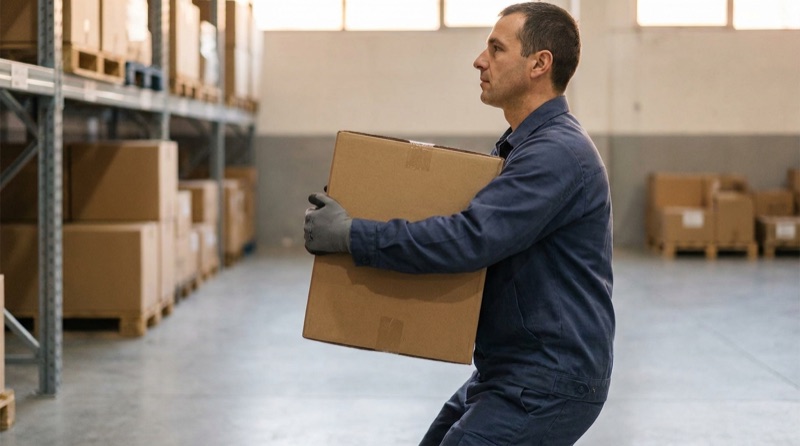
Manual handling means using your body to lift, lower, push, pull, carry, hold or restrain something, whether that is a box, a trolley, a tool or a person. Most manual tasks are fine. The ones that can injure you are called hazardous manual tasks, and they are about much more than how heavy something is.
This guide explains what counts, what makes a task hazardous, the law in plain words, safe lifting basics, and what a manual handling certificate is and is not. It is based on the Safe Work Australia Model Code of Practice: Hazardous manual tasks, with sources at the end.
What counts as manual handling?
A manual task is any job where you use your body to move or hold something. Stacking shelves, carrying a tray, pushing a trolley, wiping a bench and scanning items at a till all count. The code defines a hazardous manual task as one that needs a person to lift, lower, push, pull, carry, or otherwise move, hold or restrain any person, animal or thing, and that involves one or more of five risk factors.
What makes a manual task hazardous?
- Repetitive or sustained force, such as lifting boxes onto a pallet all shift.
- High or sudden force, such as a heavy load, or a load that slips or a person who stumbles.
- Repetitive movement, using the same body parts to make the same movement again and again.
- Sustained or awkward posture, such as bending, twisting, working above shoulder height, squatting or kneeling, or staying in one position.
- Vibration, from some tools and vehicles.
Notice that weight is not on the list. A light load can still be hazardous if it is handled over and over, held for a long time or handled in an awkward position. The code gives rough guides for "repetitive" and "long":
| Term | Rough guide in the code |
|---|---|
| Repetitive | A movement or force repeated more than twice a minute |
| Sustained | A posture or force held for more than 30 seconds at a time |
| Long duration | More than 2 hours in total over a shift, or more than 30 minutes without a break |
The code calls these guides, not magic numbers. If a task is hard on your body, it needs a closer look.
What injuries can manual handling cause?
The injury is called a musculoskeletal disorder (MSD): an injury to, or disease of, the muscles, bones, joints, tendons, ligaments or nerves. It includes sprains and strains, back injuries, joint injuries, nerve problems such as carpal tunnel syndrome, hernias and long-term pain. The code describes MSDs as the most common workplace injuries across Australia. They can build up slowly or happen suddenly.
Is there a maximum weight you can lift at work?
No. There is no legal lifting limit in Australia that applies to everyone. The Safe Work Australia code explains that there is no safe weight for all workers in all circumstances, because weight is only one of many things that add to the risk. How bulky the load is, how often you lift it, how high or low, how far you carry it, the floor, the heat and how you feel that day all matter.
A rule such as "never lift more than a set number of kilograms" may be a workplace rule, and you should follow your workplace rules. But the law expects your employer to look at the whole task, not just the weight.
The law in plain words
Most Australian states and territories use the model Work Health and Safety (WHS) laws. Victoria has its own: the Occupational Health and Safety Act 2004 and the OHS Regulations 2017, with Part 3.1 covering hazardous manual handling. The ideas are close. Under the model laws:
- The employer (called a PCBU) must eliminate the risk. If that is not reasonably practicable, they must minimise it as far as is reasonably practicable (section 19 of the WHS Act).
- Part 4.2 of the WHS Regulations deals with hazardous manual tasks. It requires the employer to manage the risk of musculoskeletal disorders and to think about postures, movements, forces, vibration, how long and how often the task is done, the work conditions, the layout and the load.
- Employers must consult workers who may be affected, and must give information, training and instruction that is suitable and adequate.
- Workers must take reasonable care of their own health and safety and others', follow reasonable instructions and cooperate with workplace safety policies (section 28).
A code of practice is practical guidance. Following it is a good way to meet the law. The Victorian Compliance code on hazardous manual handling works the same way there.
The hierarchy of control: fix the task first
The code ranks ways to control a risk from strongest to weakest, and employers should start at the top.
| Level | What it means | Manual handling example |
|---|---|---|
| Eliminate | Get rid of the hazard or the task | Deliver goods straight to where they are used so they are not handled twice |
| Substitute, isolate or engineering | Swap in something safer or change the equipment | Trolleys, hoists, lift tables, lighter packs, height-adjustable benches |
| Administrative | Change how people work | Job rotation, planned rest breaks, safe work procedures |
| Personal protective equipment | Equipment worn by the worker | Gloves for hot items, cushioned footwear on hard floors |
The code says administrative controls and PPE do not control the hazard at the source, which is why "be careful when you lift" is a weak control by itself.
Safe lifting basics
Before you lift anything, ask whether you need to lift it by hand. Can you use a trolley, split the load, get help or have it delivered closer? If a manual lift cannot be avoided, these tips are widely used good practice. They are not rules from the code, and no technique makes an unsafe load safe.
- Look at the load, the path and where it is going. Clear clutter first.
- Stand close to the load with your feet about shoulder-width apart.
- Get a firm grip and keep your back in its natural shape, bending knees and hips as needed.
- Keep the load close to your body.
- Lift smoothly, without jerking. Sudden, jerky force is especially hazardous.
- Turn by moving your feet, not by twisting your back.
- Stop and get help if you cannot see over the load, cannot get a good grip, the load shifts, or you feel pain.
The code also says pushing is usually better than pulling. When you push, you use more of your body weight and can see where you are going. Team lifts bring their own risks and are best for rare tasks, not regular ones.
What is a manual handling certificate?
A manual handling certificate is generally a record that you completed manual handling training. The name is used for many different courses, so what it means depends on who issued it and what the course covered. Before you pay for one, check what your employer or site actually asks for.
Our Manual Handling Awareness (online) course is a non-accredited awareness course. You finish short online lessons, pass an online quiz (80% to pass, unlimited attempts), and receive a Certificate of Completion from Melbourne Tech Institute straight away. It takes about 1.5 to 2 hours. The course costs $49 including GST. It is not a nationally recognised qualification, there is no USI to provide, and it does not replace the training your employer must give you on the tasks and equipment at your own workplace. Enrol here, or see all our courses.
Report aches and pains early
Most manual task injuries build slowly: a niggle, then an ache, then pain that will not go away. The code says early reporting lets employers put controls in place before an injury happens. Tell your supervisor or health and safety representative about discomfort that keeps coming back, even if you are the only person affected.
Sources
- Safe Work Australia, Model Code of Practice: Hazardous manual tasks (2020): https://www.safeworkaustralia.gov.au/system/files/documents/1905/model-cop-hazardous-manual-tasks.pdf
- WorkSafe Victoria, Compliance code: Hazardous manual handling (2019): https://content-v2.api.worksafe.vic.gov.au/sites/default/files/2020-02/ISBN-Compliance-code-hazardous-manual-handling-2019-12.pdf
This guide is general information, not legal or medical advice. Looking after a fire safety plan too? See our guide to fire extinguisher colours and types. Working in care? Read manual handling in aged care.
What is manual handling?
Using your body to lift, lower, push, pull, carry, hold or restrain a person, animal or thing. It becomes a hazardous manual task under the Safe Work Australia code when it involves repetitive or sustained force, high or sudden force, repetitive movement, sustained or awkward posture, or vibration.
Is there a maximum weight you can lift at work in Australia?
No. Australian work health and safety law does not set one lifting limit for everyone. The Safe Work Australia code says there is no safe weight for all workers in all circumstances, so the whole task has to be assessed. Your workplace may have its own limits, and you should follow them.
What is a manual handling certificate?
Usually a record that someone finished manual handling training. Ours is a Certificate of Completion for a non-accredited awareness course. It is not a nationally recognised qualification, and it does not replace the training your employer must give on your own tasks and equipment.
Does my employer have to train me in manual handling?
Under the model WHS Regulations, employers must give workers information, training and instruction that is suitable and adequate for the work, the risks and the controls in place. That includes the tasks and equipment at your own workplace. A general online course can add to this but cannot replace it. Victoria has its own rules.
Is lifting with your legs enough to stay safe?
No. Good technique helps, but the Safe Work Australia code ranks training and instruction among the weaker controls. Employers are expected to look first at changing the task, the equipment or the layout.