
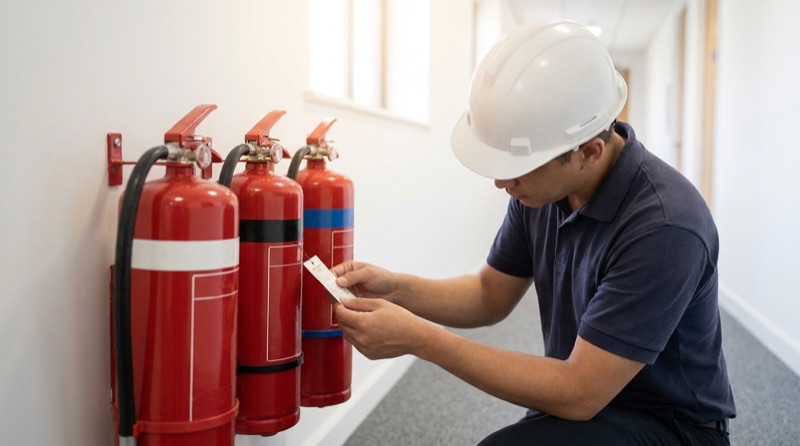
Australian fire extinguishers are red, with a coloured band that shows the type. The CFA (Country Fire Authority) lists four common colours: a red band for water, a blue band for foam, a white band for dry chemical powder and a black band for carbon dioxide (CO2). Which one you need depends on what is burning, and the label on the extinguisher says what it is for.
This guide explains the colours, the six fire classes (A to F), which extinguisher suits which class, and how to use one with the PASS steps. Every fact comes from the CFA page on fire extinguishers, linked in the sources at the end.
Fire extinguisher colours at a glance
Here are the colours the CFA gives for the most common extinguishers in workplaces. The Type column is the extinguishing agent inside.
| Extinguisher type | Colour (CFA) | What it is mainly used for |
|---|---|---|
| Water | Red with a red band | Class A: wood, paper and textiles |
| Foam | Red with a blue band | Class A, and Class B flammable liquids |
| Dry chemical powder (ABE or BE) | Red with a white band | A wide range of fires. The type letters show which classes. |
| Carbon dioxide (CO2) | Red with a black band | Class E: energised electrical equipment |
| Wet chemical | The CFA page does not give a band colour. Read the label. | Cooking oil and fat fires (Class F), and Class A |
| Vaporising liquid | The CFA page does not give a band colour. Read the label. | Class A and E, with limits on B and C |
The band is a quick guide, not a replacement for reading the extinguisher. The CFA says the label and the ID disc above the extinguisher tell you what kind of fire it can be used on.
What colour is a dry chemical extinguisher?
A dry chemical powder extinguisher is red with a white band. The CFA says these are widely used in commercial settings because they work on a range of fires. There are two types, and the difference matters:
- ABE powder suits wood, paper and textile fires (Class A), flammable liquids (B), flammable gases (C) and electrical equipment (E). It is not marked as suitable for cooking oils and fats.
- BE powder suits flammable liquids (B), gases (C), electrical equipment (E) and cooking oils and fats (F). It is not marked as suitable for wood, paper and textile fires.
Both have a white band, so check the letters on the label before you rely on one.
What colour is a carbon dioxide extinguisher?
A carbon dioxide (CO2) extinguisher is red with a black band. It is commonly used on electrical fires, and the CFA table marks it as limited on Class A and B fires. Three cautions from the CFA:
- In an enclosed space there is a risk of not being able to breathe in enough oxygen.
- It has limited range, so you must work close to the fire.
- It has no pressure gauge, so a test fire away from the fire matters.
The six classes of fire: A to F
In Australia, fires are grouped by what is burning. The class tells you which extinguisher is safe to use.
| Class | What is burning | Examples (CFA) |
|---|---|---|
| A | Ordinary combustibles. The most common type of fire. | Wood, paper, textiles, plastics, coal |
| B | Flammable and combustible liquids | Petrol, kerosene, oil, tar, paint, wax, cleaning spirits, alcohol |
| C | Flammable gases | LPG, butane, propane, LNG, acetylene |
| D | Combustible metals | Magnesium, aluminium, potassium |
| E | Energised electrical equipment | Power boards, computers, powered technology |
| F | Cooking oils and fats | Vegetable oil, olive oil, lard, butter, dripping |
The CFA warns that water should not be used on Class B fires, especially grease fires. The CFA's table below covers classes A, B, C, E and F. It does not list Class D, so a combustible metal fire is a job for a specialist: leave and call Triple Zero (000).
Which extinguisher suits which class of fire?
This table follows the CFA's. "Yes" means suitable, "No" means not suitable and "Limited" means it works only in some conditions.
| Type | A: wood, paper | B: liquids | C: gases | E: electrical | F: cooking oils |
|---|---|---|---|---|---|
| Water | Yes | No | No | No | No |
| Wet chemical | Yes | No | No | No | Yes |
| Foam | Yes | Yes | No | No | Limited |
| Dry chemical powder (ABE) | Yes | Yes | Yes | Yes | No |
| Dry chemical powder (BE) | No | Yes | Yes | Yes | Yes |
| Carbon dioxide (CO2) | Limited | Limited | No | Yes | No |
| Vaporising liquid | Yes | Limited | Limited | Yes | No |
| Fire blanket | Limited | Limited | No | No | Yes |
There is no single extinguisher that works on every kind of fire. The CFA says the right type for a workplace depends on its fire risks, for example cooking oil and fat extinguishers belong in cooking areas. Using the wrong one can cause serious injury or make a fire worse.
Fire blankets
A fire blanket is not an extinguisher, but it appears in the CFA table. It is marked as suitable for cooking oil and fat fires (Class F) and limited on Class A and B.
How to use a fire extinguisher: PASS
The CFA teaches the PASS technique:
- Pull the pin.
- Aim the nozzle at the base of the fire, not the flames.
- Squeeze the handle.
- Sweep the nozzle from side to side.
From the CFA's demonstration: approach from upwind if you can, make sure you have a clear escape route, and walk, never run, to the fire. Test the extinguisher away from the fire first so you know how far it throws. When you move away, back off slowly and keep facing the fire in case it reignites.
Should you use an extinguisher at all?
Only if the fire is small and you feel mentally and physically able to. The CFA's advice is short: if in doubt, get out and call Triple Zero (000).
Lithium-ion battery fires
The CFA says there is currently no Australian Standard for testing extinguishers on lithium-ion battery fires, and it will not sell or service extinguishers marked for them. If a lithium-ion battery is smoking or on fire, the CFA says: don't touch the device, get everyone to leave and close doors if it is safe, and call Triple Zero (000) and say it is a lithium-ion battery incident.
Where extinguishers should be, and how they are looked after
- Keep them easy to reach, such as in hallways, kitchens and near exits, with clear space in front. They must not block exits.
- Signs showing where they are must be clearly visible from up to 20 metres and installed 2 metres or more above floor level.
- ID discs above an extinguisher tell people what kind of fire it suits.
- The CFA says portable firefighting equipment should be installed in line with Australian Standard AS 2444, and that extinguishers must be maintained under AS 1851. A building surveyor or extinguisher contractor can tell you which type you need and where.
Training: knowing is not the same as practising
The CFA recommends extinguisher training for all staff, not just fire wardens, so everyone knows where the extinguishers are, what they suit and how to use them. Reading about extinguishers helps, but a practical session at your own workplace is where you learn to handle one.
If you have been asked to be a fire warden and want a clear grounding in the theory first, see our Fire Warden Awareness (online, theory) course: $39 including GST, about 1.5 to 2 hours, with a Certificate of Completion. It is a non-accredited awareness course and not a nationally recognised qualification. It is theory only, so a fire warden must still take part in their own workplace's emergency procedures and evacuation exercise. In Queensland it is not Fire Safety Adviser training, and not your building's general or first-response evacuation instruction. Enrol here or see all our courses.
Sources
- CFA (Country Fire Authority), Fire extinguishers: https://www.cfa.vic.gov.au/fire-safety/business-and-workplace-fire-safety/essential-safety-measures-for-businesses/fire-extinguishers (page last updated 6 October 2026)
This guide is general information, not a substitute for advice from a fire protection contractor about your own premises. Pair it with our guide to manual handling at work if you are putting together a workplace safety checklist.
What colour is a dry chemical powder fire extinguisher?
Red with a white band, according to the CFA. The two common dry chemical powder types are ABE (suits Class A, B, C and E fires) and BE (suits Class B, C, E and F fires), so always read the label as well as the band.
What colour is a carbon dioxide (CO2) fire extinguisher?
Red with a black band, according to the CFA. CO2 extinguishers are commonly used on electrical fires. Be careful in an enclosed space, because you may not be able to breathe in enough oxygen.
What does PASS mean on a fire extinguisher?
Pull the pin, Aim the nozzle at the base of the fire (not the flames), Squeeze the handle, and Sweep the nozzle from side to side. Only use an extinguisher if the fire is small and you feel able to. If in doubt, get out and call Triple Zero (000).
Can I use a water extinguisher on an electrical or cooking oil fire?
No. In the CFA table, a water extinguisher is only marked as suitable for Class A fires (wood, paper, textiles and similar). Water should not be used on flammable liquid or grease fires, and it is not marked as suitable for energised electrical equipment.
How many classes of fire are there in Australia?
The CFA lists six: Class A (ordinary combustibles), B (flammable and combustible liquids), C (flammable gases), D (combustible metals), E (energised electrical equipment) and F (cooking oils and fats).