
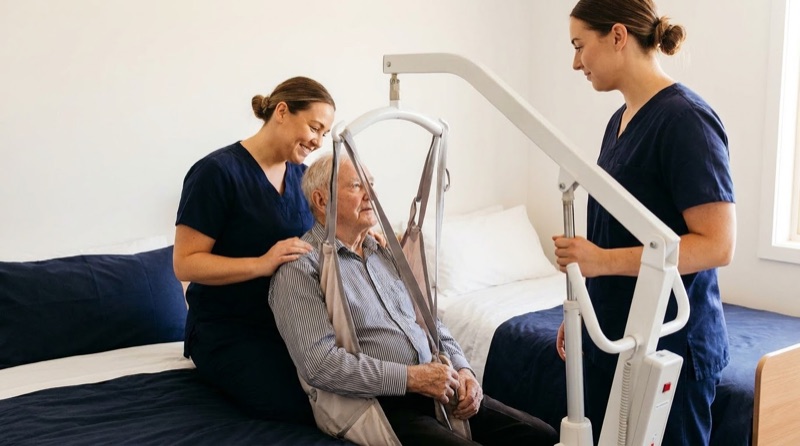
Care work has one of the biggest manual handling challenges: moving people. People are not boxes. They move, may resist, can lose balance and may not understand what is happening. The Safe Work Australia code says handling people can involve high and sudden force, and it is clear on one point: no worker should fully lift a person, other than a small infant, unaided.
This guide covers the common manual tasks in aged care, the controls the code points to (hoists, slide sheets and more), and who is responsible for training. We have not quoted injury statistics here, because we have not checked one against a source we can point you to.
Common manual tasks in aged care
| Task | Why it can be hazardous | Controls to look at |
|---|---|---|
| Moving a person in and out of bed, a chair, the shower or the toilet | High force, awkward postures, sudden movement if the person loses balance | A mobility assessment, a hoist or transfer aid, a second worker, enough space |
| Repositioning a person in bed | Reaching and bending over a bed, repeated effort | Slide sheets, height-adjustable beds, working with the person where they can help |
| Helping a person who starts to fall | Sudden, unpredictable force | Follow the person's care and mobility plan, use suitable equipment, have enough staff |
| Pushing wheelchairs, beds and trolleys | Sustained force, hard-to-start or hard-to-stop loads | Well-maintained wheels, clear and smooth floors, starting and stopping slowly |
| Bathing and dressing | Awkward postures in small bathrooms | Shower trolleys or chairs, enough space for two staff and equipment |
| Time pressure and short staffing | Pushes people to do two-person tasks alone | Enough staff and time for two-person equipment, so no one tries to do it alone |
How a workplace handles each depends on the person's needs, the building and the equipment.
Hoists, slide sheets and other aids
The code lists mechanical aids and assistive devices as the way to reduce high-force people handling. Examples named in our course material include hoists, slide sheets, transfer boards, shower trolleys and height-adjustable beds. Good practice includes:
- A mobility assessment of the person, so they can help as much as they safely can.
- Enough space in bedrooms and bathrooms for the equipment and two staff to move.
- Equipment that is easy to find and stored close to where it is used.
- Enough staff and time for equipment that needs two people.
- Regular checks of the equipment, and reporting anything broken or missing.
The person being moved matters too. Their safety, comfort and dignity are part of the job. Explain what you are doing and ask them to help if they can.
Who must train you on the equipment?
Your employer. Under the model WHS Regulations, an employer must give workers information, training and instruction that is suitable and adequate for the work and the controls in place. Do not use a hoist or similar device until you have been trained on that exact device. If a care plan changes (for example, the person can no longer help with a transfer), tell your supervisor so the plan can be updated.
What the law asks of employers and workers
- The employer (PCBU) must eliminate the risk, or minimise it so far as is reasonably practicable, and consult workers.
- Workers must take reasonable care, follow reasonable instructions, use the equipment provided as trained, and cooperate with workplace safety policies.
- Victoria has its own law (OHS Regulations 2017, Part 3.1) with similar ideas.
For the basics of the law and the hierarchy of control, see our guide: what is manual handling?
Beyond lifting people
Care work also includes laundry, meal service, cleaning, pushing trolleys and bending to low shelves. The same five risk factors (force, repetitive movement, awkward or sustained posture, vibration, and how long and how often) apply. If you do any of these, report ongoing aches early.
A short awareness course for care workers
Our Manual Handling Awareness (online) course is a non-accredited awareness course covering hazardous manual tasks, including a section on handling people in care work. It takes about 1.5 to 2 hours, costs $49 including GST, ends with an online quiz and gives you a Certificate of Completion. It is not a nationally recognised qualification and it does not replace the training your employer must give on your workplace's own equipment. Enrol here.
If you are thinking about a career in care, we also deliver separate nationally recognised qualifications: the Certificate III in Individual Support (CHC33021) and the Certificate IV in Ageing Support (CHC43015). They are different from the awareness course above.
Sources
- Safe Work Australia, Model Code of Practice: Hazardous manual tasks (2020): https://www.safeworkaustralia.gov.au/system/files/documents/1905/model-cop-hazardous-manual-tasks.pdf
- WorkSafe Victoria, Compliance code: Hazardous manual handling (2019): https://content-v2.api.worksafe.vic.gov.au/sites/default/files/2020-02/ISBN-Compliance-code-hazardous-manual-handling-2019-12.pdf
This guide is general information, not legal or medical advice. Follow your workplace's procedures and each person's care plan.
Can one carer lift a resident or client alone?
The Safe Work Australia code says no worker should fully lift a person, other than a small infant, unaided. The task should use mechanical aids, assistive devices or help from another worker.
Who trains me to use a hoist or slide sheet?
Your employer. Employers must give training and instruction that is suitable for the work and the equipment in use. Do not use a hoist until you have been trained on that exact device and have been shown how your workplace uses it.
Do I need a manual handling certificate to work in aged care?
That depends on your employer. Some ask for general manual handling awareness before you start. Ask what they accept. A general online course can help you understand the risks but does not replace training on your workplace's own equipment and care plans.
Is the Manual Handling Awareness course enough for aged care work?
No. It is a non-accredited awareness course with a Certificate of Completion, not a nationally recognised qualification. It covers the general principles, including people handling, but your employer must still train you on your own workplace's tasks and equipment.